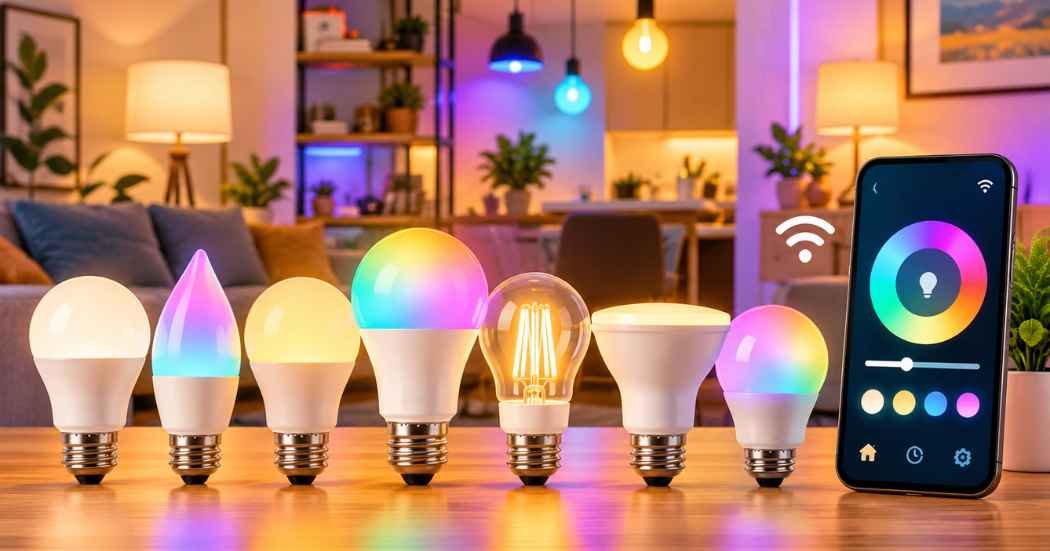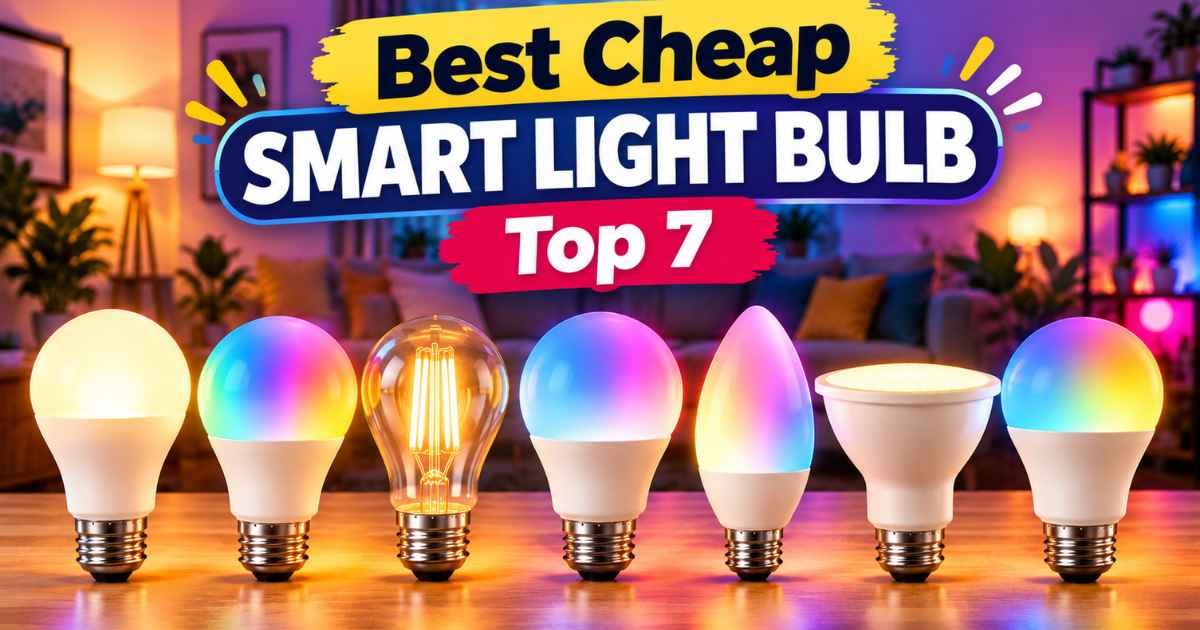
If you’re comparing cheap smart bulbs, the spec that separates them isn’t brightness — most of these sit at 800 lumens and 9 watts. It’s the ecosystem. Amazon Basics works with Alexa only, Sengled Matter talks to Alexa, Google, Apple HomeKit and SmartThings, and the rest land somewhere in between. Buyers over-weight color count, but the number that changes daily life is the dimming floor: Kasa’s KL110 dims down to 1%, while Amazon Basics starts at 5%. For a smart bulb that just works, the Kasa Smart KL110 leads on the spec you’ll actually notice.
Head to Head on What Matters
Voice Assistant Compatibility
This is the axis that decides whether a bulb fits your home or fights it. Amazon Basics is the most locked-in: the listing says it works exclusively with Alexa and isn’t compatible with Google Assistant, Apple HomeKit or SmartThings. Sengled Matter goes the other way, listing Google Assistant, Apple HomeKit and Samsung SmartThings support. Kasa KL110 names Alexa, Google Assistant and Microsoft Cortana. Feit Electric names Alexa and Google Assistant. Govee and Linkind both name Alexa and Google Assistant too. Sylvania’s listing says compatible with Alexa and Google Home only, and Globe’s says Works with Alexa Only.
Dimming Range
Dimming range is where the listings genuinely differ, and it’s the number buyers skip. Kasa KL110 states a range from 1% to 100% — the lowest floor of any bulb here. Amazon Basics states 5% to 100% and adds a real limit: dimming works through the Alexa app or voice only, not a physical dimmer. Linkind says it isn’t compatible with dimmer switches either. Govee says it can’t be used with smart switches. Feit, Sylvania, Sengled and Globe don’t print a dimming percentage in the data given, so treat their floors as unknown rather than poor.
Color Range and White Tones
Color is where the marketing gets loud, so read carefully. Govee claims millions of colors plus 54 preset scene modes. Feit claims over 16 million colors with tunable whites and a CRI of 90+. Linkind claims 16 million colors with a white range of 1800K to 6500K. Amazon Basics is the outlier in the other direction: 16 preset color selections, not millions. Kasa KL110 is soft white only at 2700K — no color at all. Sylvania offers full color and tunable white, and Sengled lists multicolor. If color variety matters most, Govee and Feit lead. If you just want warm white light, Kasa’s single tone is the whole point.
What the Numbers Mean for You
A dimming floor sounds technical until it’s 11 p.m. and you want the room barely lit. A bulb that stops at 5% still glows noticeably; one that reaches 1% can sit near-dark. That difference shows up in bedrooms and nurseries, not living rooms.
Color count works the other way. Once you have millions of colors, more colors stop helping — you’ll use maybe five. What actually matters is whether the white tones shift warm to cool, because that’s the light you live under daily.
Lumens are the one number to compare honestly. Every bulb here that states output says 800 lumens, which is a standard 60-watt replacement. None of them will light a large room alone. Buy for the fixture, not the fantasy.
Wattage is the number that never changes. Every bulb in this list that states power draw uses 9 watts to replace a 60-watt incandescent. That’s the energy saving you’re actually buying, and it’s identical across brands. Don’t pick a bulb because its listing talks up efficiency.
The number that decides whether a bulb works at all isn’t on the box. It’s your Wi-Fi band. Every bulb here that names a network says 2.4 GHz, and several say plainly that 5 GHz isn’t supported.
Check your router before you order. If your network runs both bands under one name, you may need to split them in the router settings first. That step takes a few minutes and saves you a return.
One more figure worth knowing: a stated lifetime of 15,000 hours. That’s years of evening use, so treat lifespan as a tiebreaker between two bulbs you already like, not a reason to pick one.
The Picks
The Amazon Basics A19 works with Alexa only, so skip it if you use Google Assistant, Apple HomeKit or SmartThings. It gives you 16 preset colors, dimming from 5% to 100%, and setup in minutes with no hub.
The Kasa KL110 dims down to a barely-there glow and takes Alexa, Google Assistant or Cortana, but it’s soft white only, with no color changing.
The Feit A19 adds over 16 million colors and tunable white, and needs to sit within 30 ft. of your router.
1. Amazon Basics Smart A19 LED Light Bulb

Best for: Alexa households that want simple color
This bulb wins on setup simplicity if you already live in Alexa. The listing describes screw-in, open-app, done — no hub, no third-party skill, and a zero-touch option if you link it to your Amazon account at checkout. It gives you 16 preset colors and a full spread of brightness levels, plus routines that turn lights on at sunset so the house looks occupied while you’re out. Group control lets one command kill every bedroom light at once.
The trade-off is baked into the listing: it works exclusively with Alexa and won’t talk to Google Assistant, Apple HomeKit or SmartThings. Dimming runs through the app or voice only, so a physical dimmer switch won’t do it. This isn’t the bulb for a mixed smart home or an iPhone-first household.
Pros
- Works exclusively with Alexa, with zero-touch setup available
- 16 preset colors and 5%–100% brightness via app or voice
- Group control by room with a single command
- Listed as suitable for damp locations like bathrooms
Cons
- Not compatible with Google Assistant, Apple HomeKit or SmartThings
- Not compatible with a physical dimmer
- 16 preset colors rather than millions
2. Kasa Smart Light Bulb KL110

Best for: Simple setup and deep dimming
The KL110’s headline is its dimming range: 1% to 100%, the lowest floor stated by any bulb in this comparison. That matters if you want a bulb that fades to almost nothing for sleep. Setup is app-based with no hub, and it connects straight to your 2.4 GHz Wi-Fi. Voice control covers Alexa, Google Assistant and Microsoft Cortana.
What it gives up is color. This is an 800-lumen soft white bulb at 2700K, so there’s no color changing and no tunable white. If your plan involves purple movie nights, this isn’t the bulb. If your plan is warm, dimmable light that responds to your voice, the listing describes exactly that.
Pros
- Dimming range of 1% to 100%
- Works with Alexa, Google Assistant and Microsoft Cortana
- No hub required — connects to 2.4 GHz Wi-Fi
- Control from anywhere with the Kasa Smart app
Cons
- Soft white 2700K only, no color changing
- Requires a secured 2.4 GHz Wi-Fi network
3. Feit Electric Smart Light Bulbs

Best for: Color variety on a first smart bulb
Feit’s listing leans hard on color: over 16 million choices plus tunable whites from warm to cool, at a stated CRI of 90+. That combination is what makes a bulb usable all day rather than just for parties. It puts out 800 lumens from 9 watts, replacing a 60-watt incandescent, and fits a standard A19 E26 base. Voice control covers Alexa and Google Assistant, and the app handles rooms, groups and schedules.
The listed limit is range: Feit says to connect within 30 ft. of your router, and it needs the older, longer-range Wi-Fi band. That’s a real constraint in a long house or a garage far from the router. This is a good fit for an apartment or a bedroom near the hub.
Pros
- Over 16 million colors with tunable white tones
- Stated CRI of 90+
- 800 lumens while using 9 watts
- Works with Alexa and Google Assistant
Cons
- Listed connection range of 30 ft. from the router
- Requires a 2.4 GHz Wi-Fi network
4. Govee A19 Smart Bulb
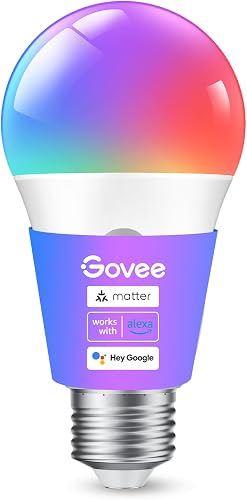
Best for: Music sync and scene modes
Govee’s pitch is effects. The listing claims millions of colors and 54 preset scene modes, and adds music sync — the bulb changes color and brightness when your phone’s microphone picks up sound. Group control extends to other Govee smart products, so the bulb can join a setup. Timer and schedule functions cover sunrise and sunset routines.
Two limits are stated plainly. Music sync only works when the microphone isn’t already in use, so a call or a recording will block it. And the bulb can’t be used with smart switches. If you want a bulb that reacts to the room, this is the one; if you want a switch on the wall to keep working normally, it isn’t.
Pros
- Millions of colors and 54 preset scene modes
- Music sync reacts to sound via your phone’s microphone
- Group control with other Govee smart products
- Timer and sunrise/sunset scheduling
Cons
- Music sync only works when the microphone is free
- Can’t be used with smart switches
- Doesn’t support 5G networks
5. Sylvania WiFi A19

Best for: Filling several rooms at once
The Sylvania listing is thin on words but the data given is specific: 800 lumens, a listed average lifetime of 15,000 hours, and full color plus tunable white in a dimmable A19. It’s compatible with Alexa and Google Home only, per the title. The four-pack is the practical detail here — this is the option for someone who wants matching bulbs across a room or a floor rather than one bulb to try out.
The trade-off is information. The listing data given doesn’t state a dimming percentage, a color count or a CRI, so those numbers are unknown from what’s here. What it does state is the lifetime figure, which no other bulb in this comparison prints. If longevity and buying in bulk matter to you, that’s the case for it.
Pros
- Four-pack for covering multiple fixtures
- Listed average lifetime of 15,000 hours
- Full color and tunable white, dimmable
- 800 lumens output
Cons
- Compatible with Alexa and Google Home only
6. Linkind Smart Light Bulbs

Best for: Wide voice support with wake-up routines
Linkind covers a lot of ground in one bulb. It lists 16 million colors with a white range from 1800K soft white to 6500K cool white. Voice control works with Alexa and Google Assistant, and there’s a free AiDot app for control from anywhere. The wake-up mode gradually shifts color over 24 hours to simulate the sun, which the listing frames around caring for elderly family members and children. Group control handles multiple bulbs over the older, longer-range Wi-Fi band.
The stated limits are the usual ones: it works only on the older, longer-range Wi-Fi band, not the faster one, and it isn’t compatible with dimmer switches. The brand leans on 20 years in lighting manufacturing for its quality claim. It’s a sensible pick if you want one bulb that covers color, temperature and scheduling without much fuss.
Pros
- 16 million colors with 1800K to 6500K white range
- Works with Alexa and Google Assistant, plus the AiDot app
- Wake-up mode simulates sunrise over 24 hours
- Group control over 2.4 GHz Wi-Fi
Cons
- Not compatible with dimmer switches
- Requires 2.4 GHz Wi-Fi, not 5 GHz
7. Sengled Matter LED Smart Light Bulb (A19)

Best for: Mixed smart homes and future-proofing
Sengled is the only bulb here whose listing names Matter certification and lists Google Assistant, Apple HomeKit and Samsung SmartThings alongside Alexa. If your home mixes an iPhone, a Google speaker and a Samsung TV, that breadth is the whole reason to pick it. It states 800 lumens at 9 watts, with the listing claiming up to 85% energy savings without losing brightness or color quality. It’s multicolor, supports groups and routines, and carries a 2-year warranty.
The bulb still needs the older, longer-range Wi-Fi band. For a single-assistant household, the extra compatibility buys you nothing.
Pros
- Matter-certified with Google Assistant, Apple HomeKit and SmartThings support
- 800 lumens at 9 watts
- 2-year warranty, the only one stated here
- Groups and routines for automation
Cons
- Supports 2.4 GHz Wi-Fi only
- Matter compatibility depends on your hub
Also Worth Considering
The Kasa Dimmable Wi-Fi Smart Bulb (KL125) is the other Kasa bulb in this comparison, so if you want Kasa’s app and setup, that’s the one to look at. The Globe LED Smart Light Bulb is an Alexa-only 800-lumen color bulb, similar in scope to the Amazon Basics pick. The DAYBETTER Smart Light Bulbs are color-changing bulbs that work with Alexa — a straightforward alternative if the main list doesn’t fit your setup.
Frequently Asked Questions
Is a bigger color number always better?
No. Govee and Feit list millions of colors, while Amazon Basics lists 16 presets — and for most people, five colors get used. What actually changes daily life is the white range. Linkind’s 1800K to 6500K span matters more than color count, because that’s the light you sit under while working or eating. Treat a huge color number as a bonus, not the deciding spec.
What does it mean when a spec isn’t listed?
It means the seller didn’t print it, and nothing more. If a listing gives no dimming percentage, you can’t conclude the bulb dims poorly — you just don’t know its floor from the page. The same goes for CRI, lifetime hours and color count. Where a number matters to you, look for it in the listing before buying, or check the manufacturer’s own specification page.
How do I compare bulbs that use different units?
Convert to what you’ll see. Lumens measure light output, so 800 lumens is the standard 60-watt replacement across these listings. Watts measure draw, and 9 watts appears on several bulbs here. Kelvin measures white tone — 2700K is warm, 6500K is cool daylight. Percentages measure dimming floors. Line up the same unit across bulbs before comparing, and never compare a lumen figure against a watt figure. They answer different questions.
Does a smart bulb need a hub?
None of the bulbs here whose listings address it require one. Those listings state no hub required and a direct 2.4 GHz Wi-Fi connection. What varies is the app and the assistant. The practical check is your Wi-Fi band: 5 GHz won’t work on any of these, so confirm you have a 2.4 GHz network before setup.
Closing Best Cheap Smart Light Bulb
If dimming is what you’ll notice every night, the Kasa Smart KL110 wins on its 1% floor and three-assistant support. If you’re honestly not sure which spec matters, the Sengled Matter A19 is the safer choice — it’s the only bulb here that lists Alexa, Google, HomeKit and SmartThings, so it fits whichever ecosystem you drift into.
Check your Wi-Fi band first. Every bulb here whose listing names a network says 2.4 GHz, and several say plainly that 5 GHz isn’t supported, so a 5 GHz-only network will stop you before any other feature matters.
Then pick your assistant, because that choice eliminates more bulbs than any other. The Amazon Basics A19 works with Alexa only, and the Globe’s title says Works with Alexa Only. Sylvania lists Alexa and Google Home only.
One more thing to check before you buy: dimmer switches. The Amazon Basics dims through the app or voice only, and Linkind and Govee state they aren’t compatible with dimmer switches, so a wall dimmer in that fixture rules those three out.