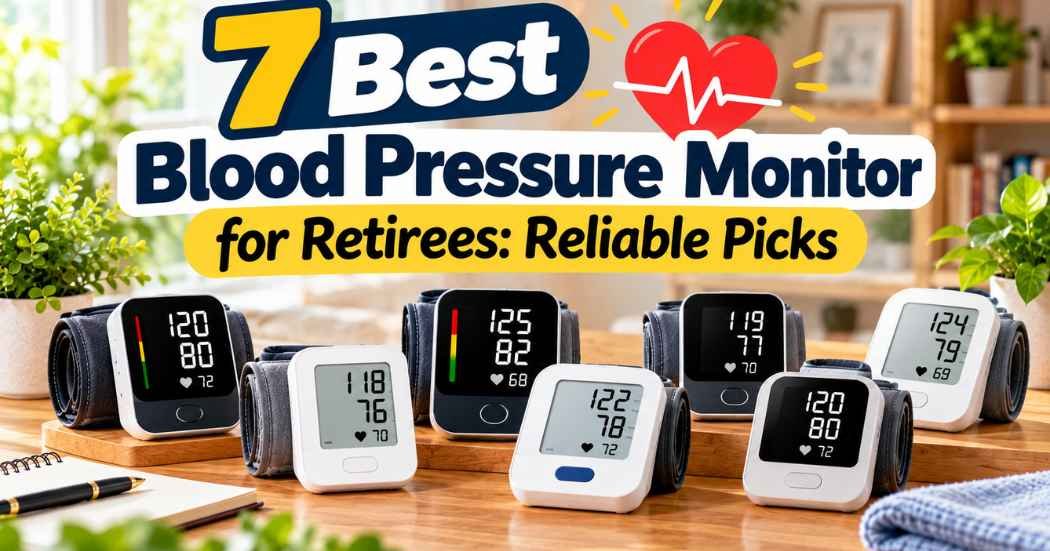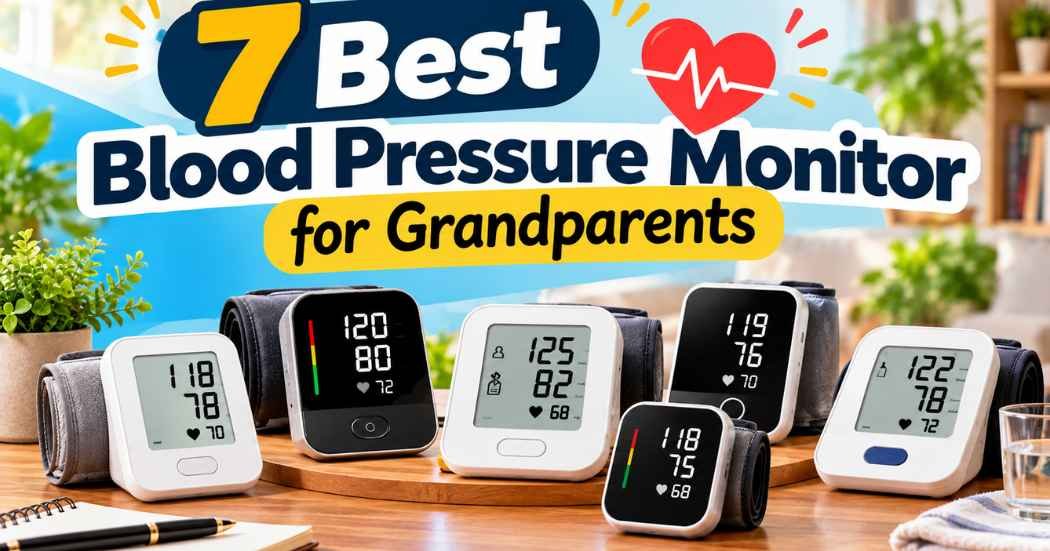
Choosing the best blood pressure monitor for grandparents can quickly feel overwhelming. Boxes display dozens of confusing symbols, technical terms, and claims about wireless connections. This guide breaks down the physical features that truly matter for older adults, like cuff sizes, display clarity, and simple power options. You will learn to distinguish a dependable machine from a confusing gadget before spending anything. For most households, the OMRON Platinum is our top pick because it includes Atrial Fibrillation detection and comes with both a wall adapter and batteries in the box.
What Actually Matters
Screen Readability and Backlighting
A screen must be legible from a sitting position without leaning forward or squinting under harsh room lighting. High-contrast numbers, large text, and bright LED backlights help seniors read systolic, diastolic, and pulse numbers easily. Some displays add color bars based on standard health ranges, which lets the user interpret results without memorizing medical charts. Before buying, check the screen dimensions and whether the digits are lit against a dark background or rely entirely on ambient room light. A monitor that can’t be read easily during an early morning checkup will quickly end up sitting unused in a drawer.
Cuff Dimensions and Self-Application
An arm cuff must fit correctly to return an accurate reading, as a band that’s too tight or loose will distort numbers. Measure the circumference of the upper arm with a soft tape measure midway between the elbow and shoulder before selecting a model. Most home units fit arms between 9 and 17 inches, but larger or smaller arms require dedicated cuffs. Look for designs with metal D-rings or pre-formed curves that allow someone with stiff fingers or limited shoulder mobility to slide the band on with one hand. A cuff that causes frustration during application leads to inconsistent daily habits.
Bluetooth and App Syncing
Wireless sync to a smartphone sounds convenient, but it often frustrates seniors who don’t want to manage phone pairings or mobile accounts. Many smart monitors hide historical data behind mobile applications, leaving only the most recent number visible on the unit itself. Reliable health tracking comes from consistency, which health organizations emphasize; for example, the American Heart Association blood pressure monitoring guidance outlines how regular at-home habits produce reliable data for doctors. Check whether the device stores past readings directly in hardware memory buttons or if it forces the user to open an app just to review yesterday’s measurements.
Power Source Flexibility
Blood pressure monitors draw significant power when the internal pump inflates the cuff, draining standard alkaline batteries after regular daily use. Units that include an AC wall adapter or a standard USB power port save users from frequent battery changes. Relying solely on small AAA batteries can lead to sudden power failures right when a doctor needs morning readings logged. Check what comes inside the package, noting whether a wall plug is included or sold separately. Having a wall plug for the bedside table alongside battery support for travel provides the most reliable everyday setup.
1. OMRON Platinum Blood Pressure Monitor & Upper Arm Blood Pressure

Best for: Comprehensive heart screening with included dual power accessories.
The OMRON Platinum provides extensive heart monitoring features by pairing standard blood pressure tracking with built-in Atrial Fibrillation detection. This added rhythm check evaluates the heartbeat during every measurement, alerting the user to irregularities that warrant a discussion with a physician. Its High Morning Average Indicator helps identify morning blood pressure spikes, which are known indicators of cardiovascular risk. These diagnostic additions offer greater confidence for seniors managing complex heart histories, though the extra on-screen alerts require some initial reading of the user manual.
In terms of power, this package includes both four AA batteries and an AC wall adapter, solving power needs immediately out of the box. The wide-range D-ring cuff accommodates arms measuring 9 to 17 inches, making it easy to slide on without assistance. Dual-user tracking holds 100 on-device readings per person, while Bluetooth lets tech-savvy relatives sync unlimited data to the OMRON connect app. This machine isn’t suitable for someone with an arm circumference over 17 inches, as the included cuff won’t close properly.
Pros
- Screens for Atrial Fibrillation during routine measurements
- AC adapter and four AA batteries included
- Stores 100 readings each for two users
- High Morning Average Indicator tracks daily spikes
Cons
- Cuff maximum reaches only 17 inches
- Screen displays multiple indicators at once
2. Automatic Blood Pressure Monitor

Best for: Straightforward one-touch use with high-contrast color numbers.
This Acenis monitor focuses on speed and basic visual clarity, featuring a large color screen built specifically for seniors with poor eyesight. It eliminates complex setup sequences by using a simple one-touch interface that delivers a complete reading within 40 seconds. The oversized color digits make it easy to differentiate between systolic, diastolic, and pulse rates without reaching for reading glasses. By keeping the interface straightforward, it removes the anxiety that often comes with confusing digital buttons and deep settings menus.
The unit includes an adjustable extra-large cuff designed to fit a wide range of arm shapes and sizes comfortably. The soft cuff material avoids uncomfortable pinching during inflation, which encourages grandparents to test their blood pressure every day. However, the listing doesn’t mention an included AC wall adapter or app connectivity for digital record sharing. This makes it an unwise choice for users who want their readings automatically emailed or exported directly to an off-site doctor.
Pros
- Large color display helps low-vision users
- Delivers complete results within 40 seconds
- Simple one-touch operation starts test quickly
- Extra-large cuff provides comfortable snug fit
Cons
- No AC wall adapter mentioned
- Doesn’t offer Bluetooth app sync
3. Upper Arm Monitor XL

Best for: Seniors needing extra-large cuff circumferences and simple power.
The Andesfit monitor solves the common problem of cuff fit by supplying two distinct bands: a standard 17-inch cuff and an extra-large 21-inch cuff. Getting an accurate blood pressure reading is impossible if the cuff can’t wrap fully, making this package helpful for larger individuals. The monitor features a massive 6-inch color LED screen that displays large, glowing numbers that are effortless to read across a table. Operating the machine takes just a single button press, allowing users to bypass complex technical menus entirely.
Power flexibility is a clear strong point here, featuring dual options between standard batteries and an included USB Type-C plug-in cable. Note that the listing states this USB port provides direct power and doesn’t recharge internal batteries. Memory capacity is generous, holding 199 readings per person across two separate profiles. The companion app connects via Bluetooth and requires no account login or personal data input, exporting history through simple CSV files. This monitor isn’t built for petite users whose arm circumference measures under 9 inches.
Pros
- Includes two cuffs fitting up to 21 inches
- Massive 6-inch backlit color LED display
- Dual power via USB Type-C cable or batteries
- Stores 199 readings each for two users
Cons
- USB connection powers unit without recharging batteries
- Large desk footprint takes up nightstand space
4. OMRON Evolv Wireless Blood Pressure Monitor & Upper Arm Blood

Best for: Wireless portability without tangled rubber air tubes.
The OMRON Evolv combines the monitor and cuff into a single, compact unit that eliminates the traditional rubber air hose. Users slide the pre-formed ComFit cuff directly onto the arm and press start, which removes the risk of dropped base stations or pinched air lines. It includes irregular heartbeat detection, which flags abnormal rhythms on the integrated screen during a normal test cycle. The internal memory saves up to 100 measurements, but the device lacks multi-user physical buttons directly on the casing.
Bluetooth connectivity links the device to the OMRON connect app, which integrates smoothly with Apple Health and Google Fit platforms. The ComFit cuff fits arms ranging from 9 to 17 inches, wrapping securely with minimal adjustment. However, because the display sits directly on the upper arm band, reading the numbers while remaining completely still can be challenging for seniors with stiff necks. Power relies entirely on four AAA batteries, meaning this unit isn’t suitable for individuals who prefer a permanent wall outlet connection.
Pros
- All-in-one design eliminates loose rubber hoses
- ComFit cuff wraps securely around upper arm
- Built-in irregular heartbeat detection alerts users
- Syncs unlimited data to free companion app
Cons
- Screen sits directly on the arm band
- Runs only on four AAA batteries
5. Greater Goods Bluetooth Blood Pressure Monitor

Best for: Dual power options and easy blood pressure cuff placement.
The Greater Goods monitor blends simple physical operation with smart digital logging, backed by five recommendations from Wirecutter. Its upper arm cuff covers circumferences from 8.7 to 16.5 inches and features an integrated artery alignment guide that helps seniors position it correctly. The large backlit screen displays systolic, diastolic, and pulse rates with high-contrast numbers, alongside an irregular heartbeat sensor. Operating the machine takes a single button press, meaning grandparents don’t need a phone present just to take an accurate reading.
For power, the kit includes an AC wall adapter for bedside use alongside a full set of batteries for travel, providing great everyday reliability. The internal memory holds 60 readings per person for multiple individuals, while the Balance Health app captures unlimited history via Bluetooth. Data can be exported to share directly with physicians or synced with Apple Health. This model isn’t built for bicep sizes exceeding 16.5 inches unless an alternative cuff is ordered separately through manufacturer support.
Pros
- Includes both wall adapter and a complete set of batteries for immediate use.
- Artery alignment guide helps proper cuff placement
- Large backlit screen offers high contrast numbers
- Physical memory holds 60 readings per user
Cons
- Included cuff tops out at 16.5 inches
- AAA batteries drain faster than larger cells
6. Konquest KBP-2704A Automatic Upper Arm Digital Blood Pressure Monitor

Best for: Offline ease with World Health Organization visual guidelines.
The Konquest KBP-2704A delivers an accessible monitoring experience for seniors who prefer an offline machine without apps or wireless pairings. It features a bright backlit LCD screen that displays blood pressure, pulse rate, time, and user profiles clearly on a single surface. Alongside the numbers, a World Health Organization indicator bar categorizes results instantly so seniors know where their health falls without checking a chart. An automatic sensor also alerts the user if an irregular heartbeat is detected during the cycle.
The included cuff wraps arms measuring 8.5 to 16.5 inches, inflating and deflating smoothly to minimize arm discomfort. The package comes with a full set of batteries, an illustrated owner’s manual, and a zippered travel case to keep components organized. It features one-touch operation to make routine testing straightforward. However, this monitor doesn’t include an AC wall adapter, and it has no Bluetooth capability for those who want automatic electronic record keeping for their doctors.
Pros
- Built-in WHO indicator categorizes readings instantly
- Bright backlit screen shows all stats together
- Detects and displays irregular heart rhythms
- Illustrated manual simplifies initial unboxing setup
Cons
- Lacks an AC wall adapter connection
- No Bluetooth sync for mobile tracking
7. A&D Medical UA-767F Blood Pressure Monitor

Best for: Multi-senior households needing separate memory tracking.
The A&D Medical UA-767F supports up to four separate user profiles, making it practical for senior living homes or multi-generational households. Each user gets 60 dedicated memory slots, and the machine includes a Snapshot Averaging tool that automatically calculates an overall baseline reading. The large LCD screen displays bold numbers for systolic, diastolic, and pulse measurements, while an on-screen alert notifies the user if the cuff is wrapped too loosely. The included wide-range cuff fits arm circumferences from 8.6 to 16.5 inches.
A physical button makes running tests simple, keeping the process stress-free for non-technical users. The unit runs on a full set of included batteries, but it doesn’t come with an AC wall adapter despite having the necessary port. While it works with the A&D Heart Track app for manual record keeping, the machine itself doesn’t feature wireless Bluetooth sync. This device isn’t ideal for someone who wants automated hands-free data uploads to their smartphone.
Pros
- Supports four separate user profiles with memory
- Snapshot Averaging calculates baseline blood pressure automatically
- Loose cuff detection warns of bad placement
- Uses long-lasting AA batteries instead of AAA
Cons
- AC wall adapter sold separately
- App requires manual entry without Bluetooth
Also Worth Considering
The iHealth Arm Blood Pressure Monitor offers smart connectivity with a wide-range cuff, suited for those who want app tracking. The Paramed Blood Pressure Monitor includes an automatic upper arm cuff fitting 8.7 to 16.5 inches, 120 memory slots, and a case. The Braun ExactFit Blood Pressure Monitors provide another home alternative focused on straightforward arm-based monitoring.
Who Should Buy Which
The OMRON Platinum is best for grandparents who want advanced heart monitoring, thanks to its Atrial Fibrillation detection and complete dual-power setup. Seniors who struggle with stiff fingers or hate tangled cables should choose the OMRON Evolv, which puts everything into an all-in-one cuff. If arm size is the primary concern, the Andesfit Upper Arm Monitor XL provides an extra-large 21-inch cuff and a massive 6-inch screen. For budget-minded buyers wanting simple offline use without apps, the Konquest KBP-2704A offers clear WHO color guides. Households with multiple older adults will get the most utility from the A&D Medical UA-767F due to its rare four-user memory system.
Mistakes That Catch Buyers Out
- Buying a monitor without measuring arm circumference first leads to buying a cuff that can’t close or produces inaccurate results.
- Choosing a smart Bluetooth machine for a senior who dislikes smartphones often leaves them unable to access historical data.
- Assuming every digital monitor includes an AC wall adapter leaves users stranded when small batteries run out of power unexpectedly.
- Trusting a cuff that inflates painfully tight causes users to skip daily monitoring habits instead of finding a wider band.
The OMRON Platinum remains the best choice for most grandparents because of its Atrial Fibrillation screening and included wall plug. Before ordering any device, wrap a flexible tape measure around the senior’s upper arm halfway between the elbow and shoulder. That single measurement ensures the included cuff fits safely and delivers accurate readings every day.
Related guides
- 6 Best Streaming Devices for Side Loading: Our Top Picks in 2026
- 7 Best Streaming Devices for Side Loading: Our Top Picks in 2026
Frequently Asked Questions
Can grandparents use these monitors with a pacemaker?
Most upper arm monitors work safely alongside pacemakers, but certain detection tools like irregular heartbeat sensors or AFib algorithms can misinterpret artificial pacing pulses. Seniors with implanted cardiac devices should always have their doctor approve a specific home monitor model. Bringing the machine to a regular cardiology appointment ensures it reads accurately alongside the pacemaker settings.
What is the difference between AA and AAA battery monitors?
Blood pressure pumps require considerable energy to inflate arm cuffs to high pressures, which drains smaller batteries quickly. Monitors powered by four AA batteries generally last longer between changes than units relying on smaller AAA cells. If a monitor uses AAA batteries, choosing a model that also includes an AC wall adapter prevents unexpected power loss.
Can an arm cuff be cleaned if it gets dirty?
Blood pressure cuffs should never be submerged in water or washed in a laundry machine because internal air bladders and valves will ruin. The fabric surface should only be wiped down gently using a soft cloth dampened with mild soapy water or an alcohol wipe. Allow the cuff to air dry completely before plugging it back into the monitor.
Why do consecutive readings taken minutes apart show different numbers?
Human blood pressure changes naturally from minute to minute based on breathing patterns, body position, talking, and anxiety. To compare readings fairly, rest quietly in a supported chair with feet flat on the floor for five minutes before taking a test. Taking two tests one minute apart and using the calculated average provides a much truer picture of baseline pressure.
Does a grandparent need an internet connection to use a Bluetooth monitor?
No, blood pressure monitors take and display measurements on their built-in screens completely offline without any internet connection. The Bluetooth feature is an optional convenience used only to transfer stored numbers onto a smartphone or tablet app. Grandparents can ignore the wireless functions entirely and rely on the physical screen and internal memory buttons.
Conclusion
Taking care of heart health shouldn’t be a chore. Once you’ve picked a device that feels comfortable to use, keep it in a spot where it’s easy to reach every morning. You’ll find that checking your numbers becomes a simple, stress-free habit that helps you stay on top of your well-being.