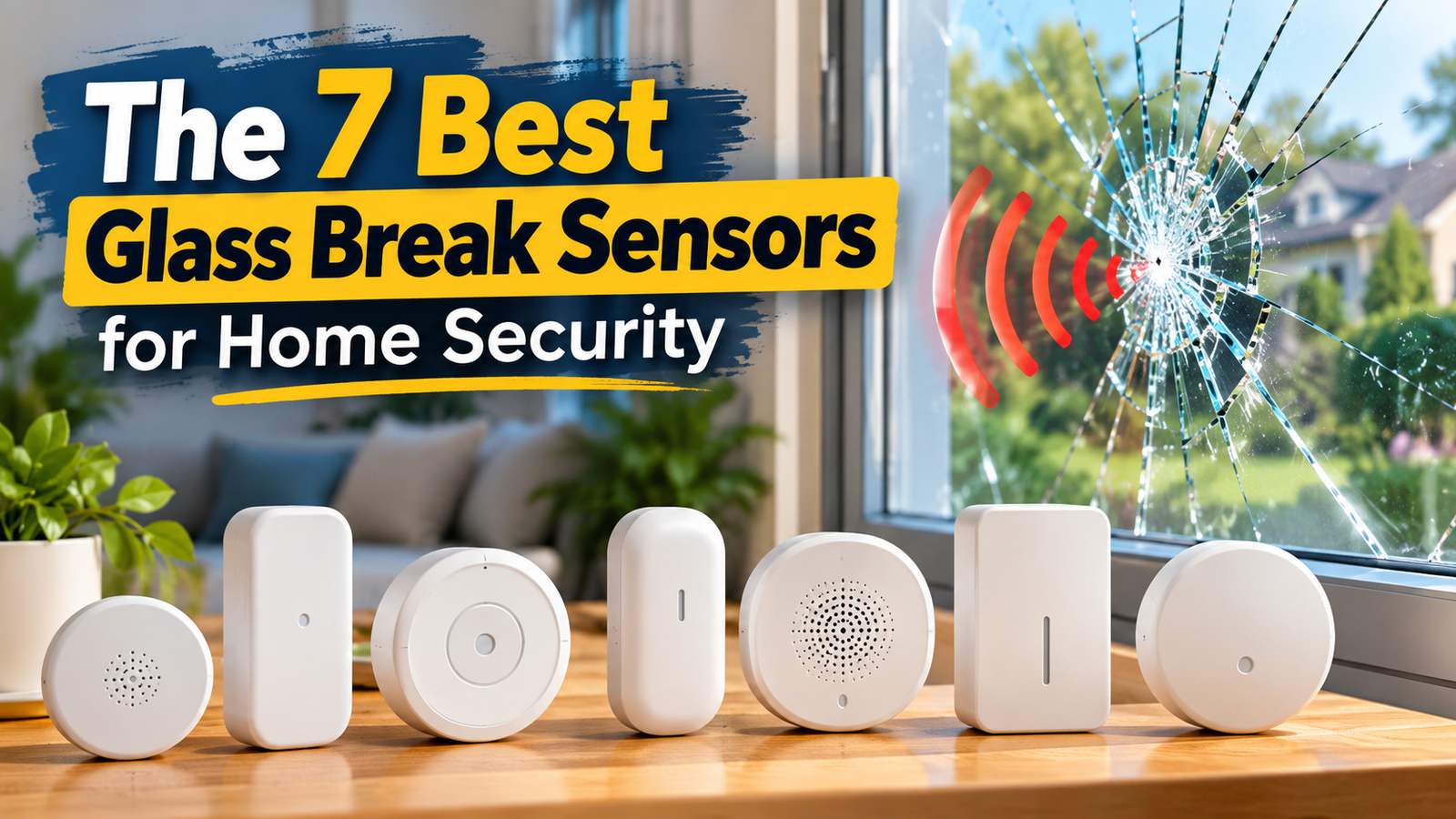
A glass break sensor listens for the sound of shattering glass and tells you about it. That sounds simple, but the shelf is confusing. Some sensors are standalone alarms that scream at 120 dB. Others are quiet parts of a bigger system, and they’ll do nothing at all on their own.
That’s the split that trips people up most when they search for the best glass break sensor. This page explains what actually matters before it names anything, then compares the sensors on range, power, mounting and what each one needs to work. For most people, the Ring Glass Break Sensor is the pick – it needs no base station, and Amazon Sidewalk keeps it connected even when your Wi-Fi drops.
What Actually Matters
Does it work alone, or does it need a hub?
This is the first thing to settle, and it decides everything else. A standalone alarm makes its own noise on the spot and needs nothing else. A system sensor stays silent by itself – it sends a signal to a hub, which then alerts your phone or triggers monitoring. Both are honest designs, but they solve different problems. Check the listing for the word “required” or “compatible with” before you order. If you already own a security system, buy inside that brand. If you don’t, a standalone unit or a hub-free sensor saves you from buying a whole system you never wanted.
Detection range and the glass it covers
Range is the distance the sensor can hear a break from. A longer stated range covers a bigger room, or a room where you can’t mount the sensor close to the window. Just as important is glass type. A buyer can check this without tools: measure the distance from where the sensor will sit to the farthest pane, and note what kind of glass your windows use. Both numbers are on the listing.
The feature that sells it and rarely earns its place
App alerts feel like the headline. They’re also the part that depends on something else – your Wi-Fi, your hub, or a subscription. If the internet drops or the hub loses power, the alert doesn’t arrive. That doesn’t make app alerts bad. It means they’re a bonus, not the foundation. The foundation is the local alarm or the sensor’s own connection. Buy for the alert you get when everything else fails, and treat phone notifications as the extra. A buyer who checks how the sensor stays connected – not just that it has an app – ends up happier.
False alerts and how you mount it
A sensor that cries wolf gets ignored, and an ignored sensor is worse than none. Glass break detection works by sound or vibration, so a dropped plate, a slammed door or a passing truck can set it off. Listings handle this in different ways: some filter household noise, some offer selectable sensitivity, some let you tune it from gentle touch to hard knock. Mounting matters too. Before ordering, look at where you can actually place it – wall, ceiling, shelf or directly on the pane.
1. Ring Glass Break Sensor

Best for: Most homes, no base station needed
Ring built this one around sound detection, and the listing says it filters out common household noise while still recognizing breaking glass. That filtering is the whole game with acoustic sensors – a unit that hears every plate drop gets switched off within a month. It also leans on Amazon Sidewalk to stay connected when your Wi-Fi goes down, which addresses the weak point of any app-based alert. Coverage may vary, as the listing itself notes, so a large house may need more than one.
Setup runs through the Ring app and the sensor mounts on walls, ceilings or furniture near entry points. It pairs with a Ring doorbell or camera so you can see what’s happening, though those are sold separately. Ring’s 24/7 Pro Monitoring is also separate and needs a compatible subscription. This one isn’t for you if you want a loud local siren with no app, no account and no internet – it’s a notifier, not a noise-maker.
Pros
- No base station required to operate
- Filters common household noise to cut false alerts
- Sidewalk keeps it connected when Wi-Fi drops
- Mounts on walls, ceilings or furniture
- Pairs with Ring cameras for visual confirmation
Cons
- Camera and monitoring sold separately
- Coverage may vary, per the listing
- Alerts depend on the Ring app
2. SimpliSafe Glassbreak Sensor

Best for: Homes already running SimpliSafe
If you already have a SimpliSafe system, this is the straightforward add-on. The listing gives a 20 ft detection range, less than some rivals here. It detects the sound of breaking glass and triggers an alarm, and the SimpliSafe app sends phone alerts when something’s wrong. That’s the pattern: the sensor hears, the system reacts, your phone tells you.
Installation is peel-and-stick, or you can place it on a shelf or use the included hardware. Setup continues in the SimpliSafe app. The listing says it’s compatible with the SimpliSafe Gen 3 system, and that’s the line that matters – this isn’t for anyone outside the SimpliSafe ecosystem, and not for a renter who wants a self-contained alarm with its own siren.
Pros
- 20 ft sound detection range
- Peel-and-stick or hardware mounting
- Instant phone alerts through the app
- Long-lasting battery per the listing
Cons
- Only works with SimpliSafe Gen 3
- 20 ft range suits a room, not a floor
- No standalone siren of its own
3. eufy Security Glass Break Sensor E10

Best for: eufy owners who want wide coverage
The E10 is the most specific sensor here, and the listing is unusually detailed. It requires a HomeBase – Mini, 2, 3 or Pro, each with a minimum firmware version – so check yours is updated before ordering. In exchange you get a neural chip and an AI algorithm trained on common glass types, plus stated compatibility with six glass types: plate, coated, laminated, tempered, wired and dual pane. Glass sizes from 12″ × 12″ to 32″ × 40″ and thicknesses from about 1/12″ to about 1/2″ are covered.
Coverage runs to 25 ft, and the listing states a stable HomeBase connection at open-air distances up to 656 ft. Mounting is adhesive or screw. This isn’t for someone without a compatible HomeBase, and not for anyone who wants a simple peel-and-stick alarm – the setup starts with a firmware check.
Pros
- 25 ft detection range
- Covers six glass types and many sizes
- AI algorithm trained on glass sounds
- Adhesive or screw mounting
- Long HomeBase connection distance
Cons
- HomeBase required with specific firmware
- Setup starts with a firmware check
- No standalone alarm function
4. Honeywell 5853 Wireless Glass Break Detector

Best for: Wireless installs that run for years
Honeywell’s 5853 is built for people who don’t want to think about batteries. The listing states a ten-year battery life with easily replaceable batteries, and that single number changes how you live with the thing – you mount it and forget it. It senses a variety of glass including tempered, wired, laminate and ordinary plate, and it offers four selectable sensitivity settings: Max, Medium, Low and Lowest. Four settings give you a way to calm a sensor in a noisy room.
Front and back case tamper means it notices if someone tries to open or move it. Remote test mode needs the FG-701 Tester, sold separately. This isn’t for a first-time buyer who wants an alarm that makes noise on its own – it’s a detector that reports to a panel, and the tester is a separate purchase.
Pros
- Ten-year battery life per the listing
- Four selectable sensitivity settings
- Senses tempered, wired, laminate and plate glass
- Front and back case tamper
- Easily replaceable batteries
Cons
- Tester for remote test mode sold separately
- Needs a compatible panel to report to
- No built-in siren
5. Honeywell Intellisense FG-1625 Acoustic Glassbreak Sensor 25 Ft.

Best for: Wired systems with long cable runs
This is the wired option. The FG-1625 uses a FlexCore signal processor and covers all glass types, with selectable sensitivity and a 25 ft range. Wired means no battery to change and no wireless signal to worry about – the trade is that a cable has to reach it, which is a job in a finished house. The listing also says it can be mounted anywhere, which helps when the best listening spot isn’t near an outlet or a panel.
Setup is described as easy, and sensitivity is selectable to cut false alerts. This one isn’t for a renter or anyone who wants to avoid running wire – if you can’t get a cable to the window, this sensor can’t help you, however good the detection is.
Pros
- 25 ft detection range
- Covers all glass types per the listing
- FlexCore signal processor
- Selectable sensitivity
- No batteries to replace
Cons
- Requires wiring to a panel
- Not suited to renters
- Installation depends on cable access
6. WSDCAM Glass Break Sensor Alarm 125dB Ultra-Slim Wireless Glass Break

Best for: Renters who want instant noise
The WSDCAM works differently from everything above. It’s a vibration sensor, not a sound sensor, and it makes its own noise – a 125 dB alarm with a blinking red indicator, loud enough to scare off an intruder and wake the house. That’s the appeal: no hub, no app, no account, no internet. Peel-and-stick mounting means no wiring and no screws, and the pack covers four windows or doors.
Sensitivity is adjustable from a gentle touch to a hard knock, which is how you stop it firing every time a door slams. Each sensor runs on three LR44 batteries with a stated one-year life and a low battery warning. This isn’t for someone who wants phone alerts while away – nobody texts you when this goes off, and that’s the whole point and the whole limit.
Pros
- 125 dB alarm deters on the spot
- No hub, wiring or app needed
- Adjustable sensitivity from touch to knock
- A multi-pack sized for a set of windows
- Low battery warning
Cons
- No phone alerts when you’re out
- A full year of battery life per the listing
- Vibration sensing, not sound sensing
7. Modern Ultra-Thin Window Alarm with Loud 120dB Sound and Vibration

Best for: Windows, with a visual deterrent
EVA LOGIK’s alarm is also vibration-based, with a 120 dB siren and high and low sensitivity settings to cut false alarms. The red LED flashes every 4 seconds as a visible warning, and a continuously lit LED means the battery is low – a small detail that saves you from a dead alarm you thought was armed. The pack includes deterrent stickers, which do quiet work before anyone touches a window.
Installation is wire-free and runs on 3A batteries, which aren’t included, so plan for that before the box arrives. Each unit covers one window. This isn’t for anyone who needs remote notification or monitoring – it protects the window it’s stuck to, and nothing beyond it.
Pros
- 120 dB alarm with flashing LED
- High and low sensitivity settings
- Low battery indicated by a lit LED
- Deterrent stickers included
- Wire-free peel-and-stick setup
Cons
- Batteries not included
- No remote or phone alerts
- Covers only the window it’s mounted on
Who Should Buy Which
Match yourself to the job, not the feature list. If you’ll use it hardest – a big house, several entry points, cameras you already own – the Ring Glass Break Sensor fits, because it needs no base station and keeps working when Wi-Fi drops. Buying your first one? The WSDCAM Glass Break Alarm gives you a loud noise on the spot with no account, no app and nothing else to buy.
Want the fewest things to go wrong? The Honeywell 5853 and its stated ten-year battery mean you mount it once and stop thinking about it. Replacing something that let you down? The eufy Security E10 publishes its glass types and sizes, so you can confirm it covers your actual windows before it arrives. Already inside SimpliSafe or eufy? Stay in that system – the SimpliSafe Glassbreak Sensor and the E10 slot straight in.
Mistakes That Catch Buyers Out
- Buying a system sensor when you have no system – many glass break sensors stay silent alone and need a hub or panel to do anything at all.
- Chasing app alerts and ignoring the local alarm – notifications depend on Wi-Fi, a hub or a subscription, and they stop when any of those do.
- Assuming the sensor covers every window – range is measured from where it’s mounted, so a 20 ft sensor in a long room leaves the far pane unwatched.
- Taking the loudest claim at face value – a big dB number or a wide range only helps if the sensor is rated for your glass type and your mounting spot.
Frequently Asked Questions
Do I need a hub for a glass break sensor?
It depends on the model. Some work completely alone and sound their own alarm on the spot. Others are system sensors – they detect a break and send a signal to a hub or panel, which then alerts you. Check the listing for “required” or “compatible with” before ordering. If you don’t own a security system, a standalone alarm or a hub-free sensor saves you from buying one.
What’s the difference between a sound sensor and a vibration sensor?
A sound sensor listens for the acoustic signature of shattering glass and can cover a whole room from one spot. A vibration sensor sticks to the glass or frame and reacts to physical shaking. Sound sensors cover more area per unit. Vibration sensors are simpler and need no hub, but they only protect the window they’re mounted on.
How far can a glass break sensor detect?
Ranges in this group run from 20 ft to 25 ft, measured from the sensor to the glass. That covers a normal room. For a large open-plan space, or a room where the sensor can’t sit close to the windows, plan on more than one unit. The stated range is the number to check against your own room.
Will a glass break sensor go off from everyday noise?
It can, which is why sensitivity settings and noise filtering matter. Some models filter common household sounds, some offer selectable sensitivity levels, and vibration units let you tune from a gentle touch to a hard knock. Mounting helps too – a sensor fixed to a solid surface triggers less than one on a rattling frame.
Do glass break sensors work during a power cut?
The ones that run on batteries keep detecting, and a standalone alarm will still sound. What changes is the alert reaching your phone: if your Wi-Fi or hub is down, app notifications may not arrive. That’s why a local siren matters. Some sensors also use a secondary connection to stay linked when the internet drops, though coverage varies.
Conclusion
If you want one name, it’s the Ring Glass Break Sensor – no base station, noise filtering, and a connection that holds when Wi-Fi drops. Before you order, measure the distance from where the sensor will sit to your farthest pane, and check your glass type against the listing. That one check decides whether a single unit will do.