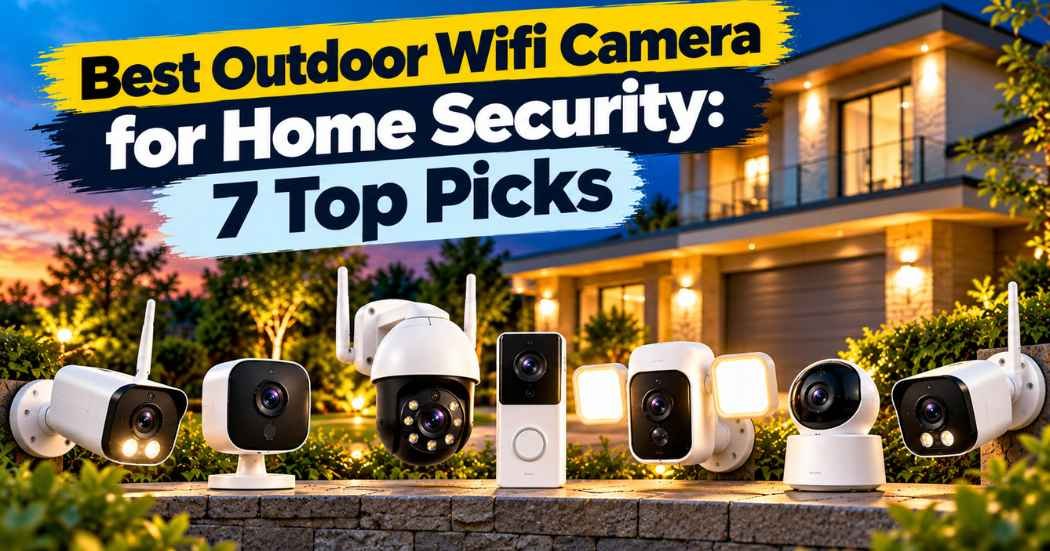
Picking the best outdoor wifi camera for home security isn’t as simple as grabbing the first one you see. The confusion starts fast because every listing promises clear video and easy setup. But what separates a good one from a bad one is how it handles power, storage, and your specific yard layout. This page will teach you what actually matters before it recommends anything, so you aren’t guessing when you click buy.
The listings were compared on their own listed specs to determine what each option includes, what materials they’re built from, and who they leave out in the cold. For most people, the Blink Outdoor 4 is the pick, simply because its listing states a two-year battery life and includes the Sync Module Core right in the box.
What Actually Matters
Power Source: Battery vs. Solar vs. Wired
How your camera gets power decides where you can put it and how often you’ll think about it. A wired camera like a pan/tilt model never dies, but you must run a cable to an outlet. Battery cameras go anywhere, yet you’ll take them down to recharge eventually. Solar panels aim to solve that by trickling power all day, though they need direct sunlight to work. Before ordering, check your mounting spot. If it’s shaded all afternoon, a solar panel won’t keep up, and you’re better off with a large battery or a wire.
Resolution: 1080p vs. 2K vs. 3K
Listings throw numbers like 1080p, 2K, and 3K around to sell you on sharpness. Higher resolution means more pixels, which helps when you zoom in on a face or a license plate. But it also creates larger video files that fill up storage faster. A dual-lens 3K camera sounds great until your memory card runs out of room in days. Count the megapixels if the listing gives them, or just know that 1080p covers most basic porch watching while 2K or 3K suits long driveways where details matter.
Storage: Local Cards vs. Cloud Subscriptions
This is the feature that sells the product but rarely earns its place in daily use until something goes wrong. Some cameras save video to a microSD card you buy separately. Others push you toward a monthly cloud subscription to review past events. A few offer both. If your Wi-Fi drops, cloud-only cameras stop saving history entirely. Check the listing to see if local storage is supported and what size card it takes, because buying a camera without knowing how it saves your clips leaves you blind when you need playback most.
Field of View and Pan/Tilt Range
The thing that genuinely decides whether you stay happy is how much of your yard the lens actually sees. A fixed camera stares at one spot, leaving blind spots on the edges. A pan/tilt camera rotates horizontally and vertically to cover more ground, sometimes tracking motion automatically. But mechanical parts move slower than a person running past. Measure the width of the area you want to watch. If the space is large, a fixed lens might miss the edges unless the listing specifically states a wide viewing angle or full rotation.
1. Blink Outdoor 4

Best for: Most buyers wanting long battery life without wiring.
The Blink Outdoor 4 leans entirely on its stated two-year battery life, which changes how you use it. You don’t have to plan your summer around taking it down to charge, making it fit well for high mounts or awkward corners. It records in 1080p HD and uses infrared for night live view, meaning it doesn’t blast bright lights into your neighbor’s yard after dark. The listing notes it comes as a three-camera system with the Sync Module Core included, so you aren’t left hunting for the hub that ties it together.
Where this falls short is detail. If you’re trying to read a license plate across a wide driveway, 1080p might not give you the pixels you need compared to higher-resolution options. It does what it says—runs a long time and talks back—but it keeps things simple rather than advanced.
Pros
- Two-year battery life stated in the listing.
- Sync Module Core is included in the box.
- Infrared night view avoids disturbing neighbors.
- Two-way talk lets you speak to visitors.
Cons
- 1080p resolution limits zooming into fine details.
2. eufy Security SoloCam S340

Best for: Buyers needing high resolution and solar power.
The eufy SoloCam S340 pairs a 3K dual-lens setup with a removable solar panel, aiming to eliminate battery anxiety entirely. That dual-lens design is the trade-off here: it captures ultra-clear visuals and offers 8× zoom to see details at the listed enhanced clarity range, but it relies on the sun to keep running forever. If you mount it under deep eaves where light rarely hits, the solar advantage disappears. The listing highlights 360° pan and tilt surveillance when installed vertically, letting you check the porch, backyard, and driveway from one spot.
Storage is handled locally with no monthly fee mentioned, which appeals to anyone tired of subscriptions. Installation is listed at seven minutes with a wire-free design. However, this isn’t for someone who needs a multi-camera bundle right out of the box, as the listing focuses on a single unit’s capabilities. It’s a strong choice if your mounting spot gets daily sunlight and you want sharp zoom without paying for cloud space.
Pros
- 3K resolution with dual lenses for clarity.
- Removable solar panel for continuous power.
- 360° pan and tilt when mounted vertically.
- Local storage with no monthly fees.
- Seven-minute wire-free installation stated.
Cons
- Solar panel requires consistent direct sunlight.
- Vertical installation needed for full 360° coverage.
3. Ring Outdoor Cam (Stick Up Cam)

Best for: Users already invested in the Ring ecosystem.
The Ring Stick Up Cam Battery is built for outside but ready for anywhere, using a rechargeable battery pack you insert before connecting to Wi-Fi. Its biggest strength is integration; the listing states it works with Alexa, letting you hear custom notifications on an Echo Dot or launch video on an Echo Show. You can place it on a flat surface or use the versatile mounting bracket for a wall, though a ceiling mount requires a separate accessory. This flexibility means you aren’t drilling holes immediately if you just want to test a spot.
The trade-off is that advanced features like rewinding missed events and getting intelligent alerts require a compatible Ring Protect subscription, which is sold separately. Without it, you’re mostly relying on Live View and Two-Way Talk in real time. It’s not the right pick for a buyer who refuses to deal with ongoing subscriptions or wants local SD card storage, as none is mentioned here. It thrives when connected to other Ring devices, covering every corner through a single app.
Pros
- Rechargeable battery makes placement flexible.
- Works seamlessly with Alexa-enabled devices.
- Versatile mounting bracket included for walls.
- Live View and Two-Way Talk built-in.
Cons
- Advanced alerts require separate subscription.
- Ceiling mount bracket sold separately.
4. TP-Link Tapo 1080P Outdoor Wired Pan/Tilt Security Camera

Best for: Locations with accessible power outlets nearby.
The TP-Link Tapo C500 takes a different route by being a wired camera, which means it never needs a battery swap or a sunny day to function. That constant power drives its 360° horizontal and 130° vertical viewing range, allowing smart AI to identify a person and track their motion with high-speed rotation. Night vision reaches up to 98 ft. You get a physical privacy mode where the housing blocks the lens, a rare feature for outdoor units.
Because it’s wired, you can’t just stick it on a fence at the back of a large yard without running a cable. It requires 2.4 GHz Wi-Fi, so older routers are fine, but it won’t connect to 5 GHz networks. Storage is flexible, accepting a microSD card up to 512 GB (purchased separately) or a cloud service. It’s not for the renter who can’t drill holes or run wires along exterior walls, but it suits homeowners wanting uninterrupted tracking and long-range night clarity.
Pros
- Wired power means no battery recharging ever.
- Night vision reaches up to 98 ft clearly.
- Physical privacy mode blocks the lens mechanically.
- Supports microSD cards up to 512 GB.
- Smart AI tracks motion with high-speed rotation.
Cons
- Requires a wired power connection outdoors.
- Only supports 2.4 GHz Wi-Fi networks.
- MicroSD card must be purchased separately.
5. SEHMUA 2K Solar Security Cameras Wireless Outdoor

Best for: Covering multiple areas with solar power.
The SEHMUA 2K Solar 2-Pack gives you two cameras with removable solar panels, designed for 365-day protection without swapping batteries. They record in 2K resolution and use a powerful white spotlight alongside infrared LEDs to capture color pictures in the dark. The listing claims a five-minute installation, supporting the lower-frequency WiFi band, and allows wall or ceiling mounting to fit your layout.
A PIR motion sensor aims to reduce false alarms from blowing branches, sending instant alerts instead. Storage uses a built-in memory card slot for cards up to 128GB (not included) or an optional 30-day cloud trial. The IP65 weatherproof rating means it handles heavy rain and snow. It’s not for someone whose router only broadcasts a 5GHz signal, as the listing explicitly states 5GHz Wi-Fi isn’t supported. It fits buyers needing to cover a front door and a backyard simultaneously without buying separate units.
Pros
- Includes two cameras and two solar panels.
- Color night vision with built-in spotlight.
- PIR sensor reduces false motion alarms.
- IP65 weatherproof rating for harsh conditions.
- Five-minute installation time stated.
Cons
- Memory cards up to 128GB not included.
- Doesn’t support 5GHz Wi-Fi connections.
6. aosu Solar Camera Outdoor Wireless

Best for: Set-and-forget solar monitoring with tracking.
The aosu Solar Camera uses a fixed solar panel and app voice guidance to walk you through setup, aiming for permanent use once installed. It shoots in 2K resolution and features panoramic PTZ (pan/tilt/zoom) that rotates wherever you tap on the screen. When human motion is detected, it automatically focuses on and tracks the moving people, recording detailed events without you steering it manually. The listing states daily direct sunlight is enough to power it continuously, keeping it 100% wireless.
It carries an IP65 weatherproof rating and works with Alexa and Google Assistant. Support includes lifetime technical support via local phone service and a one-year replacement policy. Like the others, it connects only to the lower-frequency WiFi band. The trade-off with automatic tracking is that if two people enter the frame from opposite sides, the camera has to choose one to follow. It’s not for users living in heavily wooded lots where direct sunlight rarely reaches the panel, as the “forever power” claim depends entirely on daily sun exposure.
Pros
- Automatic human tracking records detailed events.
- Fixed solar panel provides continuous power.
- App voice guidance simplifies the setup process.
- Lifetime technical support and one-year replacement.
- Compatible with Alexa and Google Assistant.
Cons
- Requires daily direct sunlight to function continuously.
- Connects exclusively to the lower-frequency WiFi band.
7. 2026 Enhanced 2K UHD Security Cameras Wireless Outdoor

Best for: Homes with modern dual-band Wi-Fi routers.
The Enhanced 2K UHD Camera by realhide stands out by supporting both 2.4GHz and 5GHz WiFi, addressing the laggy streams common on crowded neighborhood networks. That dual-band capability is its main selling point, ensuring rock-solid connections where older cameras drop offline. It records in 2K UHD with full-color night vision powered by an upgraded built-in spotlight. The high-capacity rechargeable battery delivers up to six months of power, varying by detection frequency, so you aren’t climbing ladders constantly.
Storage is highly flexible here. It offers free rolling cloud storage alongside a local SD card slot accepting up to 256GB, meaning recordings stay safe even if your WiFi goes down. The housing carries an IP66 weatherproof rating, a step above the IP65 seen on several others, handling dust and heavy rain. It suits those who’ve struggled with connection drops on older single-band devices.
Pros
- Supports both standard and high-frequency WiFi bands.
- Free rolling cloud storage included alongside SD.
- IP66 weatherproof rating handles extreme conditions.
- Up to six-month battery life stated.
- Accepts SD cards up to 256GB locally.
Cons
- Battery life varies by detection.
Who Should Buy Which
If you use your yard hard and need constant tracking without battery worries, the TP-Link Tapo C500 fits, provided you can run a wire. For someone buying their first security camera who wants a straightforward setup, the Blink Outdoor 4 is a strong start because the Sync Module Core is already in the box and the battery offers extended multi-year runtime. If you’re replacing a camera that kept dropping offline due to network congestion, the Enhanced 2K UHD Camera solves that with dual-band WiFi support.
Buyers wanting to cover multiple zones at once should grab the SEHMUA 2K Solar 2-Pack, as it hands you two units with PIR sensors. Those determined to never plug in a charger again, assuming their roof gets sun, will lean toward the eufy SoloCam S340 or the aosu Solar Camera for their removable or fixed solar setups. Finally, if your whole house already runs on smart doorbells and Echo speakers, the Ring Stick Up Cam slots directly into that existing app.
Mistakes That Catch Buyers Out
- Buyers often judge these cameras solely on resolution numbers like 3K or 2K, ignoring that higher resolutions fill up local storage cards much faster and require stronger Wi-Fi to stream smoothly.
- Assuming a “wireless” camera means zero maintenance catches people off guard when they realize battery-powered models still need to be taken down and charged every few months without a solar add-on.
- Taking the loudest claim in a listing at face value, like “forever power” on solar models, leads to disappointment when buyers mount them under shaded eaves where panels can’t gather enough daily sunlight.
For most people, the Blink Outdoor 4 remains the pick because it includes the necessary hub and states a two-year battery life. Before you order any model on this list, go outside and measure the distance from your router to the mounting spot. Check your router’s broadcast bands to confirm if it pushes a 5GHz signal or only 2.4GHz, since buying a single-band camera for a crowded network causes dropped feeds.
Frequently Asked Questions
Do I need a hub for outdoor Wi-Fi cameras?
It depends on the brand. Some systems require a central module to connect cameras to your router, saving battery life. The Blink Outdoor 4 includes its Sync Module Core in the box. Other brands connect directly to Wi-Fi without extra hardware. Always check the listing to see if a hub is included or required.
Will these cameras work if my Wi-Fi goes down?
Most cameras lose their ability to send live alerts to your phone if the internet drops. However, models with local storage can still save video. The Enhanced 2K UHD Camera offers an SD card slot up to 256GB, and the TP-Link Tapo C500 takes cards up to 512GB. If you rely solely on cloud subscriptions without a memory card inserted, you won’t have a record of events during an outage.
How much sunlight does a solar camera actually need?
Solar cameras need direct light hitting the panel, not blazing heat. Listings for models like the aosu Solar Camera state that daily direct sunlight powers it continuously. Mounting the panel under thick branches or deep overhangs prevents it from generating enough energy. You can usually extend the cable to place the panel in the sun while keeping the camera shaded.
What does the IP65 or IP66 rating mean for rain?
These ratings tell you how well the housing seals out dust and water. The first number covers solid particles, and the second covers liquids. An IP65 rating, found on SEHMUA and aosu models, protects against water jets from any direction. The Enhanced 2K UHD Camera lists IP66, which withstands more powerful jets. Both survive standard outdoor storms without leaking.
Can I talk to delivery drivers through these cameras?
Yes, two-way audio is a standard feature across almost all these listings. Models like the Ring Stick Up Cam and the Blink Outdoor 4 specifically highlight two-way talk, allowing you to hear and speak through the mobile app. The TP-Link Tapo C500 adds customizable sound alarms, letting you play a recorded message instead of speaking live. Just ensure your phone’s volume is up when you answer the notification to hear them clearly.
Conclusion Best outdoor wifi camera for home security
Don’t let the boxes sit unopened in your hallway. Pick a spot near your door this weekend, mount it up, and check the phone feed while you’re still outside. You’ll see right away if the angle covers what matters or if you need to shift it over.