Finding the best brand camera for home security isn’t about picking one winner for everyone. It’s about matching a specific camera’s power source, resolution, and storage method to your actual property layout and daily habits. Many buyers get stuck comparing specs that don’t matter while missing the trade-offs that determine whether they’ll actually use the system six months from now. This guide breaks down those real differences before recommending anything, so you can choose based on capability rather than marketing claims. For most people starting out, the Blink Outdoor 4 offers a balanced entry point because its two-year battery life removes the friction of frequent recharging that causes many systems to fall into disuse.
What Actually Matters
Power Source Determines Placement Freedom
Battery-powered cameras go anywhere but require maintenance intervals you must accept. Wired models provide continuous recording and brighter lights but limit placement to where electrical access exists. The trade-off isn’t just convenience versus performance; it’s whether you’ll keep the system active long-term. A dead battery means zero coverage until you notice and replace it. Before ordering, count how many outdoor outlets you have within reach of your desired camera spots and decide if running extension cords or hiring an electrician fits your timeline. Your honest answer here eliminates half the options immediately.
Resolution Versus Storage and Bandwidth Costs
Higher resolution captures more detail but demands faster Wi-Fi, larger storage cards, and more bandwidth for live viewing. A 4K camera on a congested network delivers choppy footage that defeats its purpose. Check your router’s age and your internet upload speed before chasing megapixels. Most homes built before 2018 struggle with multiple high-resolution streams simultaneously. The spec sheet lists maximum resolution, not sustainable performance under your actual network conditions. Match the camera’s output to what your infrastructure can reliably handle every single day, not just during setup.
Local Versus Cloud Storage Trade-offs
Cloud storage offers offsite backup but requires ongoing subscriptions that accumulate over years. Local microSD storage avoids monthly fees but leaves footage vulnerable to theft if someone takes the camera itself. Some brands force cloud plans for advanced features like person detection even when local recording is technically possible. Read the fine print on which alerts work without a subscription before assuming “local storage” means full functionality.
Weather Ratings Define True Outdoor Capability
Not all “outdoor” cameras survive the same conditions. Temperature operating ranges vary significantly between models, and IP ratings specify exact protection levels against dust and water ingress. A camera rated for indoor use with a weather-resistant adapter isn’t equivalent to one engineered for permanent exterior mounting. Verify the stated temperature range covers your region’s extremes, including both summer highs and winter lows. The manufacturer’s specification page lists these limits precisely because exceeding them voids warranties and causes premature failure. Don’t assume outdoor branding equals universal weatherproofing.
1. Blink Outdoor 4

Best for: Wire-free outdoor coverage with minimal maintenance
The Blink Outdoor 4 runs on AA lithium batteries rated for up to two years, which fundamentally changes how you interact with your security system compared to rechargeable alternatives. You install it once and forget about power for seasons at a time, but battery operation only supports motion-triggered clips. The included Sync Module Core handles local storage via microSD card (sold separately), giving you a path away from mandatory cloud fees that many competing systems enforce.
Person and vehicle detection require a Blink Subscription Plan sold separately, meaning the base hardware alone provides only basic motion alerts without smart filtering. The 1080p HD resolution captures usable daytime footage but won’t match the detail level of 2K or 4K alternatives when identifying faces at distance. Weather resistance spans -4°F to 113°F, covering most continental US climates without issue. Two-way audio lets you speak through the app. Alexa compatibility enables voice-armed routines and multi-camera views on Echo Show devices.
Pros
- Two-year battery life reduces maintenance frequency significantly
- Sync Module Core enables optional local microSD storage
- Weather-resistant design operates across wide temperature range
- Compact form factor mounts discreetly on siding or trim
Cons
- Smart detection features require separate subscription plan
2. Anona 4K UHD Indoor Camera

Best for: High-detail indoor monitoring with pan-tilt coverage
The Anona 4K UHD captures four times the pixel count of standard 1080p cameras, but that resolution only matters if your Wi-Fi 6 network can sustain the data throughput without dropping frames. Dual-band support lets you assign the camera to 5GHz for cleaner video transmission while keeping other devices on 2.4GHz, yet this advantage disappears in homes still running older routers. The 360° pan and 110° tilt eliminate blind spots in rectangular rooms, making one unit cover what would normally require two fixed cameras. This model fits pet owners or parents wanting maximum detail for indoor spaces, but it’s unsuitable for anyone lacking Wi-Fi 6 infrastructure or needing outdoor-rated hardware since the listing specifies indoor use only.
AI detection distinguishes persons, pets, and baby crying sounds without requiring a subscription tier, which separates it from brands gating these features behind paywalls. Local storage accepts microSD cards up to 512GB, providing weeks of 4K footage before overwriting begins, though cloud backup remains available through Anona’s encrypted service. The 8x digital zoom helps inspect details in recorded footage but can’t create optical clarity that wasn’t captured originally. A privacy mode is available for when you are home. Auto-tracking follows moving subjects automatically, useful for monitoring active pets but potentially distracting if triggered by ceiling fans or shadows.
Pros
- 4K resolution captures exceptional detail for identification
- AI detection works without mandatory subscription fees
- Dual-band Wi-Fi 6 supports stable high-bitrate streaming
- Pan-tilt mechanism covers entire room from single position
- Supports up to 512GB microSD for extended local storage
Cons
- Requires Wi-Fi 6 router for reliable 4K performance
- Indoor-only rating excludes outdoor or garage use
- Digital zoom can’t recover lost optical detail
3. Ring Floodlight Cam Plus

Best for: Deterrence through illumination and audible warnings
The Ring Floodlight Cam Plus delivers 2000 lumens of motion-activated light plus a 105dB siren, creating active deterrence that passive recording cameras simply can’t match. Hardwired installation provides unlimited power for continuous operation and bright lighting, but this permanently ties the camera to your home’s electrical system and requires junction box access. Motion zones let you exclude streets or neighbor yards from triggering alerts, reducing notification fatigue that plagues poorly configured systems. This camera serves properties needing visible security presence and nighttime illumination, but it’s the wrong choice for renters or anyone unable to run wiring to their desired mounting location since battery alternatives don’t exist in this product line.
1080p HD video records continuously when paired with a Ring Protect subscription (sold separately), enabling retrospective review that battery cameras can’t offer. The siren activates manually through the app or automatically with motion, though automatic triggering risks false alarms startling neighbors. Color night vision improves identification after dark when floodlights aren’t triggered, supplementing the primary illumination system. Alexa integration allows voice commands for live view and custom notifications through Echo devices. Real-time alerts arrive instantly upon motion detection, but intelligent alerts distinguishing people from animals require the paid subscription tier. Professional installation may be necessary if existing wiring doesn’t reach your preferred mounting spot.
Pros
- 2000-lumen floodlights provide genuine area illumination
- Hardwired power enables continuous recording and lighting
- Customizable motion zones reduce false alert triggers
- Integrated siren adds active deterrence beyond recording
- Color night vision supplements floodlight coverage
Cons
- Requires hardwired electrical installation at mount point
- Intelligent alerts need separate Ring Protect subscription
- Permanent mounting limits repositioning after installation
4. Tapo 2K Pan Tilt Security Camera
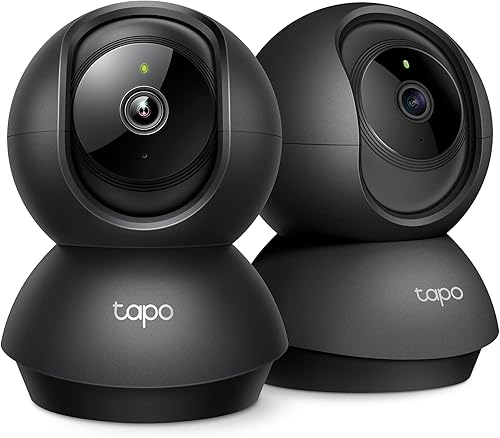
Best for: Whole-room coverage with flexible storage
The Tapo C211 combines 2K resolution with 360° horizontal and 114° vertical pan-tilt range at a positioning that prioritizes accessibility over premium features. Person and baby crying detection work without any subscription fee, removing the recurring requirement that makes many competitors dependent on paid plans over time. Local microSD storage up to 512GB operates independently of cloud services, giving you complete ownership of your footage without vendor lock-in. This camera suits first-time buyers or those expanding coverage, but it lacks the 4K detail of higher-end models and connects only via 2.4GHz Wi-Fi, which may struggle in apartment buildings with congested wireless spectrum.
Motion tracking automatically follows detected subjects across the pan-tilt range, keeping people or pets centered without manual adjustment. Two-way audio enables communication through the app, functioning as both intercom and baby monitor replacement. Works with Alexa and Google Assistant for voice-controlled live view on smart displays, though casting to TV requires compatible Chromecast devices. The compact form factor sits unobtrusively on shelves or mounts to walls and ceilings. Night vision switches automatically based on ambient light, maintaining visibility around the clock. Setup takes minutes through the Tapo app, requiring no technical expertise or additional hub hardware.
Pros
- Person and crying detection included without subscription
- Full pan-tilt coverage eliminates single-position blind spots
- Local microSD storage avoids mandatory cloud fees
- 2K resolution balances detail with bandwidth efficiency
- Simple setup requires no hub or professional help
Cons
- 2.4GHz-only Wi-Fi may suffer interference in dense areas
- Lower resolution than 4K alternatives for critical identification
- Indoor-only design excludes exterior or garage placement
5. Ring Outdoor Cam (Stick Up Cam)

Best for: Flexible placement with battery or wired options
The Ring Stick Up Cam Battery operates wirelessly for true placement freedom, yet accepts optional solar panels or plug-in adapters for semi-permanent installations without committing to hardwiring. This versatility lets you test locations before finalizing mounting positions, something fixed-wire cameras can’t offer. Weather-resistant construction handles outdoor exposure while remaining compact enough for indoor shelf placement when needs change. Live view and two-way talk function through the Ring app regardless of power configuration, maintaining consistent user experience across setups. This camera fits renters and homeowners experimenting with coverage patterns, but those needing floodlight deterrence or continuous recording should look elsewhere since battery operation inherently limits both capabilities.
Color night vision improves low-light identification compared to traditional infrared, though performance still depends on available ambient light sources. Motion alerts arrive instantly, but intelligent filtering distinguishing people from animals requires Ring Protect subscription (sold separately). The versatile mounting bracket supports flat surfaces, walls, and optional ceiling mounts (sold separately), adapting to various architectural constraints. Multiple units connect through the Ring app for unified property monitoring without additional hubs. Rechargeable battery packs swap quickly, minimizing downtime during charging cycles. Alexa compatibility enables hands-free monitoring and custom notifications through Echo devices.
Pros
- Battery power enables truly wireless outdoor placement
- Accepts optional solar or plug-in power accessories
- Weather-resistant design works indoors and outdoors
- Color night vision improves low-light identification
- Versatile mounting supports multiple installation orientations
Cons
- Continuous recording requires separate subscription plan
- No integrated floodlight for active deterrence
- Battery life varies significantly with motion frequency
6. Blink Mini 2K+ (newest model)
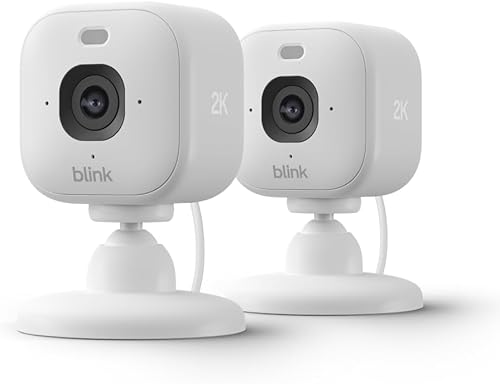
Best for: Compact indoor monitoring with enhanced audio clarity
The Blink Mini 2K+ delivers 2K resolution in a plug-in form factor that eliminates battery anxiety while maintaining the compact footprint users expect from mini cameras. Enhanced audio with noise cancellation makes two-way conversations feel more natural than previous generations, addressing a common complaint about tinny speaker quality in small cameras. Up to 4x zoom leverages the higher resolution to inspect details without losing usability, though digital magnification still can’t create information absent from the original capture. This model serves nurseries, pet monitoring stations, and entryway checkpoints where plug access exists, but it’s inappropriate for locations lacking nearby outlets or requiring weather resistance without purchasing the separate Weather Resistant Power Adapter.
Person and vehicle detection require Blink Subscription Plan (sold separately), continuing the brand’s pattern of gating smart features behind recurring payments. The camera doubles as a doorbell chime when paired with Blink Video Doorbell, providing audible alerts throughout your home without dedicated chime hardware. Cloud storage includes a free 30-day trial, letting you evaluate the subscription value before committing. Night vision maintains visibility in darkness, though 2K sensors typically show more noise in low light than 1080p equivalents. Alexa integration supports voice commands for arming, disarming, and live view on compatible Echo devices. Installation takes minutes with no tools required beyond finding an outlet.
Pros
- 2K resolution provides meaningful detail improvement over 1080p
- Noise-cancelled audio improves two-way conversation quality
- Plug-in power eliminates battery maintenance entirely
- Functions as doorbell chime with compatible Blink doorbells
- Compact size fits discreetly on shelves and window sills
Cons
- Smart detection requires separate Blink subscription
- Requires nearby electrical outlet for operation
- Outdoor use needs separately sold weather adapter
7. Blink Outdoor 4 XR

Best for: Large properties needing extended wireless range
The Blink Outdoor 4 XR uses the Sync Module XR hub operating on the 900MHz band to achieve 1000 feet open-air range or 400 feet typical use, solving the distance limitations that plague standard Wi-Fi cameras on expansive lots. This lower frequency penetrates walls and foliage better than 2.4GHz signals, delivering 70% fewer disconnects according to the listing’s specifications.
Live view accesses 20% faster despite the longer range because the dedicated band avoids household Wi-Fi congestion. The batteries last as long at the edge of the property as they do near the house thanks to Blink’s patented chip technology. This system serves rural properties, large estates, and detached garages beyond normal Wi-Fi reach, but it’s overkill for urban lots under 100 feet where standard Outdoor 4 units perform identically at lower complexity.
Local storage via microSD card (up to 256GB, sold separately) works through the Sync Module XR, avoiding cloud dependency while maintaining the extended range benefits. The system supports up to 10 Blink devices controlled from a single app interface, enabling comprehensive property coverage without managing multiple networks. Weather resistance matches the standard Outdoor 4, operating from -4°F to 113°F across all cameras in the system.
Alexa compatibility extends to long-range routines, allowing voice control of distant cameras through the same hub. The XR technology is proprietary to Blink’s ecosystem, meaning you can’t mix third-party cameras into this extended network. Installation mirrors standard Blink setup with the added step of positioning the XR hub optimally between your router and farthest cameras.
Pros
- Extended range covers large properties beyond Wi-Fi reach
- 900MHz band reduces disconnects in challenging environments
- Two-year battery life maintained at maximum distance
- Local storage option avoids mandatory cloud subscription
- Supports up to 10 cameras on single XR hub
Cons
- Proprietary XR technology locks you into Blink ecosystem
- Overkill for small urban lots within normal Wi-Fi range
- Requires optimal XR hub placement for advertised range
Ring Indoor Cam offers straightforward 1080p HD indoor monitoring for users already invested in the Ring ecosystem who don’t need pan-tilt functionality. Tapo Indoor Security Camera provides basic 1080p coverage with wired reliability for buyers accepting lower resolution. Security Camera systems with solar power and dual-band Wi-Fi present an alternative for off-grid locations where neither battery replacement nor wiring is practical, though multi-pack configurations suit different use cases than single-unit reviews address here.
Who Should Buy Which
Homeowners with large rural properties should choose Blink Outdoor 4 XR because its 900MHz extended range solves distance problems no standard Wi-Fi camera can handle. First-time buyers wanting simple outdoor coverage without wiring commitments fit Blink Outdoor 4’s maintenance-free runtime perfectly. Parents and pet owners needing maximum indoor detail belong with Anona 4K UHD, provided their network supports Wi-Fi 6 throughput.
Those requiring active deterrence through lighting and sirens must select Ring Floodlight Cam Plus since passive recording alone doesn’t prevent incidents. Expanders adding indoor coverage should consider Tapo C211 for its subscription-free smart detection. Renters needing flexible placement benefit from Ring Stick Up Cam’s battery-versus-wired adaptability. Anyone replacing failed cameras due to complex setup should stick with Blink Mini 2K+ for its plug-in simplicity and proven reliability.
Mistakes That Catch Buyers Out
Assuming “outdoor” labeling means universal weatherproofing without checking the specific temperature operating range listed for your climate zone leads to premature failures in extreme heat or cold. Choosing 4K resolution without verifying your router supports Wi-Fi 6 and your internet upload speed sustains multiple high-bitrate streams results in choppy footage that wastes the premium specification. Believing local storage automatically unlocks all smart features ignores that many brands gate person detection and advanced alerts behind subscriptions regardless of where footage saves. Trusting advertised battery life estimates without accounting for your property’s actual motion frequency causes unexpected maintenance when high-traffic locations drain cells in weeks rather than years.
For most people, Blink Outdoor 4 strikes the right balance of low maintenance and adequate coverage, but verify your desired mounting locations fall within its operating temperature range before ordering. Measure your Wi-Fi signal strength at each planned camera spot using your phone’s built-in diagnostics, since listed range specifications assume ideal conditions your property may not provide.
Frequently Asked Questions
Do security cameras work without internet?
Most modern cameras require internet for setup, firmware updates, and remote access. Local recording to microSD cards continues during outages, but you cannot receive alerts or view live feeds remotely without connectivity. Some models store footage locally and sync when the connection restores, though this varies by brand.
How long do battery security cameras last?
Listed battery life estimates assume default settings and moderate motion activity. Actual duration varies dramatically with motion frequency, live view usage, night vision activation, and temperature extremes. High-traffic locations may require recharging every few weeks despite advertised runtimes. Monitor your camera’s battery percentage through the app to establish realistic expectations for your environment.
Can I use indoor cameras outdoors?
Indoor cameras lack weather sealing and temperature tolerances required for exterior exposure, risking moisture damage and component failure even under covered porches. Some manufacturers sell weather-resistant enclosures for protected outdoor locations, but these don’t convert the camera to full outdoor specification. Always verify the product listing explicitly states outdoor suitability before mounting any camera outside.
Do I need a subscription for cloud storage?
Cloud storage almost always requires ongoing subscriptions, though many brands include free trial periods ranging from seven to thirty days. Some cameras offer local microSD recording as an alternative, but advanced features like person detection frequently remain locked behind paid tiers regardless of storage method. Local storage provides ownership of footage but lacks offsite backup protection against theft or damage.
What resolution do I actually need?
1080p suffices for general activity monitoring and works reliably on most home networks without demanding excessive storage. 2K provides meaningful improvement for identifying faces and reading text at moderate distances while balancing bandwidth requirements. 4K delivers maximum detail but requires Wi-Fi 6 infrastructure, substantial storage capacity, and strong upload speeds. Match resolution to your actual identification needs and infrastructure capabilities rather than pursuing maximum specifications.
Conclusion Best brand camera for home security
Don’t overthink the specs; just pick a system that fits your routine and install it this weekend. You’ll feel safer knowing your home’s covered, and you won’t dread maintenance. Start small, test the angles, and adjust as you learn what actually matters for your space.